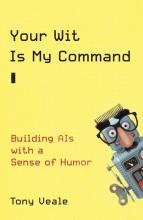
- Veale, T. (2011).
Creative Language Retrieval: A Robust Hybrid of Information Retrieval and Linguistic Creativity. In Proc. of the ACL’2011, the 49th Annual Meeting of the Association for Computational Linguistics: Human Language Technologies. [ pdf]
- Veale, T. and Hao, Y. (2011).
Exploiting Readymades in Linguistic Creativity: A System Demonstration of the Jigsaw Bard. In Proc. of the ACL’2011, the 49th Annual Meeting of the Association for Computational Linguistics: Human Language Technologies. [ pdf]
- Veale, T. and Li, G. (2011).
Creative Introspection and Knowledge Acquisition: Learning about the world thru introspective questions and exploratory metaphors. In Proc. of AAAI’2011, the 25th Conference of the Association for the Advancement of Artificial Intelligence. [ pdf]
- Veale, T. (2011).
We Can Re-Use It For You Wholesale Serendipity and Objets Trouvés in Linguistic Creativity. In Proc. of ICCC’2012, the 2nd International Conference on Computational Creativity. [ pdf]
- Hao, Y. and Veale, T. (2010).
An Ironic Fist in a Velvet Glove: Creative Mis-Representation in the Construction of Ironic Similes. Minds and Machines 20(4):635–650. [pdf]
- Veale, T., Gervás, P., Pérez y Pérez, R. (2010).
Veale, T., Gervás, P., Pérez y Pérez, R. (2010). Computational Creativity: A Continuing Journey. Introduction to the special issue on Computational Creativity. Minds and Machines 20(4):483–488. [pdf]
- Forceville, Charles, Veale, Tony and Feyaerts, Kurt (2010).
Forceville, Charles, Veale, Tony and Feyaerts, Kurt. (2010). Balloonics: The Visuals of Balloons in Comics. The RISE and REASON of Comics and Graphic Literature: Critical Essays on the Form, Edited by Joyce Goggin & Dan Hassler-Forest. [pdf]
- Cristina Butnariu, Su Nam Kim, Preslav Nakov, Diarmuid OSeaghdha, Stan Szpakowicz, Tony Veale (2010).
Cristina Butnariu, Su Nam Kim, Preslav Nakov, Diarmuid OSeaghdha, Stan Szpakowicz, Tony Veale, "SemEval-2010 Task 9: The Interpretation of Noun Compounds Using Paraphrasing Verbs and Prepositions, ACL workshop on Semantic Evaluations (SemEval 2010)), 2010, pp. 39--44. [pdf]
- Veale, T. and Hao, Y. (2010).
Veale, T. and Hao, Y. (2010). Detecting Ironic Intent in Creative Comparisons. In the proceedings of ECAI’2010, the 19th European Conference on Artificial Intelligence. Lisbon, 2010. [pdf]
- Li, G., Lopez-Fernandez, A. and Veale, T. (2010)
Li, G., Lopez-Fernandez, A. and Veale, T. (2010). UCD-Goggle: A Hybrid System for Noun Compound Paraphrasing. In the proceedings of the 5th International Workshop on Semantic Evaluation, ACL 2010, pages 230–233, Uppsala, Sweden, 15-16 July 2010. [pdf]
- Veale, T. (2007).
Veale, T. (2007). Dynamic Creation of Analogically-Motivated Terms and Categories in Lexical Ontologies. In Judith Munat (Ed.), Lexical Creativity, Texts and Contexts (Studies in Functional and Structural Linguistics), pp 189-212. Amsterdam: John Benjamins. [pdf]
-
Veale, T. and Butnariu, C. (2010).
Veale, T. and Butnariu, C. (2010). Harvesting and Understanding On-line Neologisms. Onysko, Alexander and Michel, Sascha (Eds.), Cognitive Perspectives on Word Formation. 393-416. Mouton De Gruyter. [pdf] -
Veale, T. and El Mouddeb, M. (2010).
Veale, T. and El Mouddeb, M. (2010). Similarity, Comparability And Analogy In WordNet: Squaring The Analogical Circle With Mondrian. Bhattacharyya, P., Vossen, P. and Fellbaum, C. (eds.) Proceedings of the 5th Global WordNet Conference, Mumbai, India. [pdf]
Metaphor is a fundamentally knowledge-hungry phenomenon. We need to possess knowledge about a topic (that which is described in a metaphor) and a vehicle (that which does the describing) before we can meaningfully describe one in terms of the other. Where does a computer acquire this conventional knowledge? From conventional language, which is abundant on the World Wide Web.
You can find a colorful description for almost anything in the texts of the world-wide-web. Of course, you can also find a great deal of nonsense and irrelevance too.Idiom Savant is a linguistic magnet for finding the sharpest needles in the haystacks of the internet. Enter a term of interest, such as priest or politician or critic or movie and Idiom Savant will show you two lists of resonant descriptions, divided acording to the perceived affect of the words employed: one list for positive descriptions, and another for negative descriptions. A sensible measure of pragmatic comparability (not just semantic similarity) is used to find the most comparable terms for your input, and to show you the positive and negative descriptions pertaining to those other terms also. For instance, enter the term critic and you will find apt descriptions for judge and monster also.
Dorian: Analogical Portraiture
Dorian is a knowledge-base that explores this multiplicity of categorization when dealing with proper-named entities. Dorian’s knowledge-base of proper-named entities is harvested from the Google n-grams, and associates entities with the categories that speakers most commonly attribute to them. Dorian’s knowledge-base is supplemented by the category-system in Wikipedia, which adopts a less subjective, curated approach to categorization.
Ecologists study the natural environment of plants and animals. Our plants and animals are words and concepts, and our environments are large text corpora. The Lex-Ecologist allows you to explore the rich textual environment for words provided by the text of the on-line encyclopaedia Wikipedia. Observe the behaviour of concepts in this environment: observe what they do, what is done to them, what they act upon, and how they congregrate into groups.
The Jigsaw Bard is an online application that allows you to find resonant phrases for a large range of simple properties, like quiet, or for an even larger range of complex blended properties, like quiet and calm. The Bard has already scoured vast amounts of web text to identify phrases that have a resonant quality, and has automatically indexed these phrases on the properties they most poetically suggest. Most phrases are found art in this respect -- they are well-formed fragments of English that the Bard thinks have both a poetic quality and a useful communicative function. But some phrases (shown in blue) have been directly composed by the Bard itself. Have a look and see what you think of the Bard’s compositional abilities.
Aristotle: An Interactive Metaphor Finder
Let Aristotle help you find appropriate metaphors to describe a given person or thing. Simply enter the target for your metaphor (called the tenor in metaphor research), choose a property you would like to accentuate, and Aristotle will select a range of possible vehicles to carry this meaning. Click on any of these vehicles to understand the full import of the metaphor you are about to use.
Sardonicus is a simile-finder that knows the exemplary properties of different objects in the real world. It has acquired this knowledge by sifting the contents of the web in search of meaningful comparisons. It knows that ninjas are stealthy and that bowling balls are heavy and smooth enough to be called bald. It also has a healthy sense of irony, so it knows that roller-coasters are not exactly a model of consistency, and that turtles are not generally prized for their speed. The similes in Sardonicus are divided into straight-faced "factual" similes and tongue-in-cheek "ironic" similes, and are organized hierarchically using a taxonomy of adjectives. Try it now, it might put an ironic smile on your face.
Mondrian: Mapping of Names, Descriptions and Roles in Analogy
Mondrian is a knowledge-base of commonplace associations that have been mined from the Google n-grams database of frequent web-content.
Mondrian views the world as a collection of triples, of the form Subject-Relation-Object.
You can query Mondrian to see what triples have a given Subject, Relation or Object (or any combination of these).
For instance, put Rabbi in the Subject field and Mondrian will give you all its triples in which Rabbi is the subject.
When you click on a relation, Mondrian shows you analogies for this relation. Mondrian uses the squaring rule to detect analogies: S1-R-O1 is analogical to S2-R-O2 if Mondrian thinks that S1-like-S2 and O1-like-O2. Hence, Mondrian builds squaring relations between parallel triples.
Click on a column of the relations table to see the table re-sorted with that column as a key.
Mondrian will also show you the common compounds that a subject engages in.
Click here to see Mondrian in action.
Different languages tend to represent different cultural and conceptual perspectives on the world. To the originating culture, such lexicalized perspectives may seem entirely conventional and stale, but to another they may well provide fresh and even innovative insights into the meaning and creative uses of words. DimSum aims to mine these insights from the lexical structure of Chinese, a logomorphemic language that exhibits its semantic structure quite openly in its orthographic realization.
Language is a dynamic landscape in which words are not fixed landmarks, but unstable signposts that switch directions as archaic senses are lost and new, more topical senses, are gained. Frequently, entirely new lexical signposts are added as newly minted word-forms enter the language. One can experience the variety and inventiveness of the most creative new words in English with ZeitGeist, a creative neologism generator.
A levels-based grid game in which you must use your world knowledge to safely navigate each level to the next progression point. Avoid falling into pits of ignorance when you fail to answer questions correctly. The topology of the game as well as each question/puzzle is computer generated using WordNet.
Play a demo version of this game
Another levels-based grid game, in which you must use your world knowledge to find a path between different start/endpoints in Wikipedia (e.g., from Zeus to Haircream). Each level has successively longer paths for you to navigate, but hints are liberally sprinkled around each level.
Play a demo version of this game
This is a game that exploits a player’s knowledge of compound terms in a language. One must blaze a trail through a matrix of words, from the top row to the bottom, forming a chain composed of two-word compound terms. That is, each successive pair of words in the chain must comprise an established two-word phrase, like "queen mother" or "mother goose" (as in the chain "queen mother goose").
Play a demo version of this game


Research Mission
Metaphor Eyes
Idiom Savant
The Lex-Ecologist
Jigsaw Bard
Sardonicus
DimSum
ZeitGeist
The Way of Knowledge
Wiki-Wanderer
Trail-Blazer